Lassen wir uns eher zu einer Geldspende hinreißen, wenn wir zuvor die Hand des Fragestellers geschüttelt haben?
Keywords: Psychologie – Beeinflussung – Berührung – Sozialpsychologie – Händedruck – Händeschütteln
Besprochene Studien:
Guéguen, N. (2013). Handshaking and compliance with a request: A door-to-door setting. Social Behavior and Personality: an international journal, 41(10), 1585-1588.
- Versuchspersonen: 37 Anwohner
- zwei Studenten (20 Jahre) gingen von Haus zu Haus und baten um Spenden für die “Hoffnung für Madagaskar – Association”:
- “Hallo. Ich bin Freiwilliger Helfer für die “Hoffnung für Madagaskar – Association” und sammle Geld für unsere Organisation um Kindern in Madagaskar zu helfen. Wären Sie bereit einen Euro zu spenden?”
- Eine Hälfte der Probanden wurde mit einem Handschlag begrüßt.
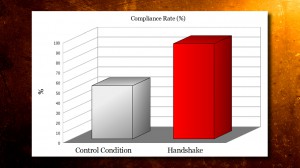
53% vs. 96%
-> Vielleicht wurden die Fragesteller als freundlicher wahrgenommen.
-> Vielleicht wurde aber auch ein (unbewusstes) Verhaltens-Skript aktiviert: Verträge werden per Handschlag besiegelt.
Kritik: Geringe Versuchspersonenzahl!
Literatur
Chaplin, W. F., Phillips, J. B., Brown, J. D., Clanton, N. R., & Stein, J. L. (2000). Handshaking, gender, personality, and first impressions. Journal of Personality and Social Psychology, 79, 110-117. http://doi.org/bhrrtt
Crusco, A. H., & Wetzel, C. G. (1984). The Midas touch: The effects of interpersonal touch on restaurant tipping. Personality and Social Psychology Bulletin, 10, 512-517. http://doi.org/ cv7zrn
Goldman, M., Pulcher, D., & Mendez, T. (1983). Appeals for help, prosocial behavior, and psychological reactance. The Journal of Psychology: Interdisciplinary and Applied, 113, 265-269. http://doi.org/fnc472
Guéguen, N., & Joule, R. V. (2008). L’effet d’influence du toucher sur la soumission à des requêtes: Une méta-analyse [The effect of touch on compliance with a request: A meta-analysis]. Cahiers Internationaux de Psychologie Sociale, 80, 39-58. http://doi.org/c3qqrm
Guéguen, N., Meineri, S., & Charles-Sire, V. (2010). Improving medication adherence by using practitioner nonverbal techniques: A field experiment on the effect of touch. Journal of Behavioral Medicine, 33, 466-473. http://doi.org/d9bwmb
Guéguen, N., & Pascual, A. (2003). Status and people tolerance against ill-mannered person: A field study. Journal of Mundane Behavior, 4, 1-8. Hall, E. (1966). The hidden dimension: Man’s use of space in public and private. New York: Anchor Books/Doubleday.
Hornik, J. (1987). The effect of touch and gaze upon compliance and interest of interviewees. The Journal of Social Psychology, 127, 681-683.
Hornik, J. (1992). Tactile stimulation and consumer response. Journal of Consumer Research, 19, 449-458. http://doi.org/c24vng
Juhnke, R., Barmann, B., Vickery, K., Cunningham, M., Hohl, J., Smith, E., & Quinones, J. (1987). Effects of attractiveness and nature of request on helping behavior. The Journal of Social Psychology, 127, 317-322. http://doi.org/fm7ctf
Kleinke, C. L. (1977). Compliance to requests made by gazing and touching experimenters in field settings. Journal of Experimental Social Psychology, 13, 218-223. http://doi.org/fwc5ft
Lynn, M., Le, J.-M., & Sherwyn, D. (1998). Reach out and touch your customers. Cornell Hotel and Restaurant Administration Quarterly, 39, 60-65. http://doi.org/bf53pq
Ohbuchi, K., Chiba, S., & Fukushima, O. (1996). Mitigation of interpersonal conflicts: Politeness and time pressure. Personality and Social Psychology Bulletin, 22, 1035-1042. http://doi.org/d59pgx
Paulsell, S., & Goldman, M. (1984). The effect of touching different body areas on prosocial behavior. The Journal of Social Psychology, 122, 269-273. http://doi.org/ckvv6g
Segrin, C. (1993). The effects of nonverbal behavior on outcomes of compliance gaining attempts. Communication Studies, 44, 169-187. http://doi.org/ffvjvd
Shipps, E. M., & Freeman, H. R. (2003). Handshake: Its relation to first impressions and measured personality traits. Psi Chi Journal of Undergraduate Research, 8, 144-148.
Smith, D. E., Gier, J. A., & Willis, F. N. (1982). Interpersonal touch and compliance with a marketing request. Basic and Applied Social Psychology, 3, 35-38. http://doi.org/fdhttw
Stephen, R., & Zweigenhaft, R. L. (1986). The effect on tipping of a waitress touching male and female customers. The Journal of Social Psychology, 126, 141-142. http://doi.org/ffzsv8